
What Is a Level of Care Assessment? How Senior Communities Decide the Right Support

A level of care assessment is a structured review, usually led by a nurse or care team, of a person's physical health, cognition, and ability to handle daily tasks. Senior communities use it to decide whether someone belongs in independent living, assisted living, memory care, or skilled nursing, and to build a care plan matched to those needs.
What Is a Level of Care Assessment?
Rather than relying on a family's description alone, a nurse or care coordinator reviews the person's medical history, observes how they manage routine activities, and asks direct questions about safety, memory, and mood.
The result serves two purposes:
Placement. It determines which setting fits: residential (independent) living, assisted living, memory care, skilled nursing, or short-term rehabilitation.
The care plan. It spells out the help the person will receive: how often staff check in, which tasks need assistance, how medications are handled, and what to watch for.
In California, licensed assisted living and memory care communities are required to complete a pre-admission appraisal. The assessment is a regulated part of responsible care, not a sales formality.
What the Assessment Evaluates
Activities of daily living (ADLs)
These basic self-care tasks determine how much hands-on support a person needs:
Bathing and showering
Dressing and grooming
Toileting and continence
Transferring (getting in and out of bed or a chair)
Walking and moving around
Eating
Instrumental activities of daily living (IADLs)
These are the more complex tasks required to live independently:
Managing medications
Preparing meals
Housekeeping and laundry
Shopping and errands
Managing money and bills
Using the phone
Arranging transportation and keeping appointments
Other areas the care team reviews
Mobility and fall history. Gait, balance, walker or wheelchair use, and any falls in the past year.
Medication management. Whether doses are taken reliably and whether any require nursing administration.
Cognition and memory. Orientation, short-term recall, and judgment, often using a brief screening tool.
Behavior and mood. Depression, anxiety, agitation, and any history of wandering or exit-seeking.
Nutrition. Weight changes, appetite, swallowing difficulties, and dietary restrictions.
Medical conditions. Chronic diagnoses, recent hospitalizations, wounds, and anything needing clinical oversight.
Social needs. Isolation, family involvement, and what makes a good day for this person.
Who Performs the Assessment, and When
A licensed nurse usually completes the assessment, often with input from a care director, social worker, or therapy staff. The person's physician typically contributes a report covering diagnoses and medications.
Assessments happen at several points, not just once:
Before move-in, to confirm the right setting and build the initial care plan.
After a hospital stay, since illness, surgery, or a fall can change what someone needs.
On a regular schedule, often every six to twelve months.
When something changes, such as new confusion, weight loss, repeated falls, or a shift in mood.
A level of care decision is a starting point, not a permanent label.
What to Expect During the Assessment
Most families find the process more conversational than clinical. It generally has three parts.
An interview with your parent and family. The nurse asks your loved one about their routine and preferences, and asks family members what they have observed. Both perspectives matter, because older adults sometimes understate difficulties.
A review of records. The physician's report, hospital discharge summaries, medication lists, and any home health or rehabilitation notes.
Direct observation. The nurse may watch your parent walk, stand up from a chair, or explain how they manage their pills. This is not a test to pass. It makes sure the care plan reflects what really happens.
The process typically takes an hour or two. If you are exploring options in Eagle Rock or Northeast Los Angeles and are unsure what level of support makes sense, you can schedule a tour and talk with our team about how the assessment works.
How Results Map to Levels of Care
There is no formula, and two people with the same diagnosis can land in different settings. Still, certain needs tend to point in a clear direction.
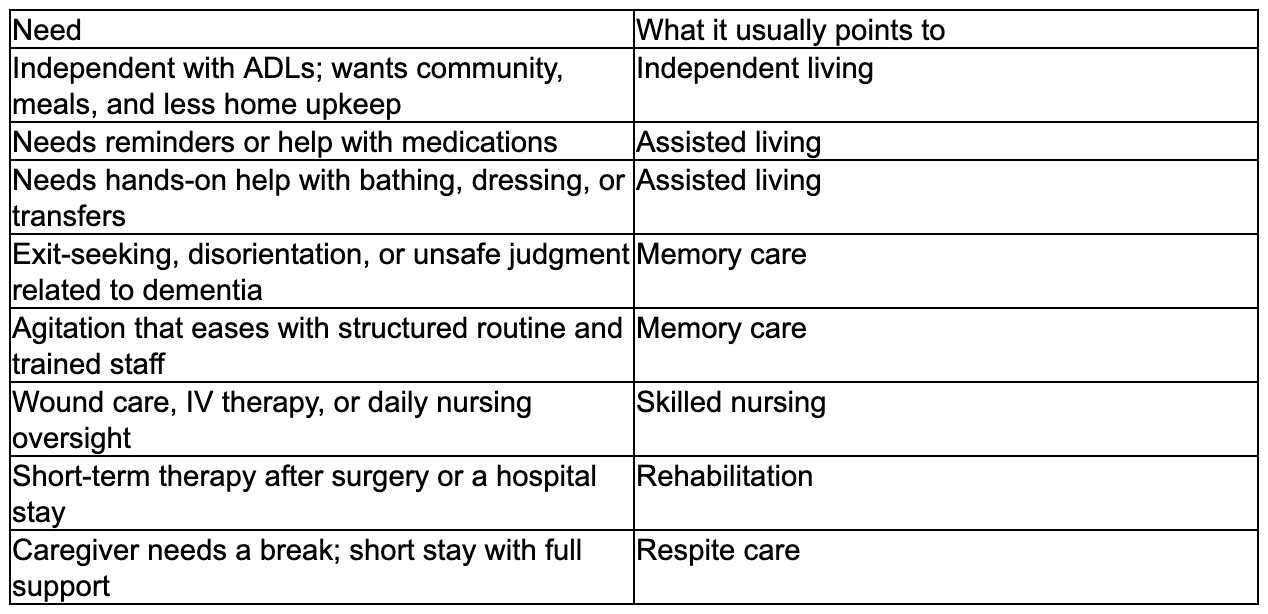
Someone can have memory loss and still be well served in assisted living if they are safe and not at risk of wandering. Skilled nursing is about clinical need, not age. Rehabilitation is often a short chapter before returning to a lower level of care. For a closer look at the two most commonly confused settings, see what makes dedicated memory care different from assisted living.
Why the Assessment Also Affects Cost
Most communities price care in tiers. The base rate covers housing, meals, and general services; the assessment determines the care tier layered on top. More hands-on help or specialized memory care programming means a higher tier.
This is why an honest assessment matters. Underestimating needs leads to gaps; overestimating means paying for support your parent does not use. Pricing varies by care level, support needs, apartment type, and services, so families should speak directly with each community about what a given tier includes. Our article on the cost of assisted living in Los Angeles explains what drives the numbers.
How to Prepare as a Family
Bring:
A current medication list, including over-the-counter drugs and supplements, and who fills the pill organizer today.
Recent hospital or rehab paperwork, especially discharge summaries and therapy notes.
Honest notes on a typical day. Is your parent eating? Skipping showers, missing doses, getting lost driving, leaving the stove on? Write down what you have seen, even if it feels disloyal to say out loud.
Your own questions, such as how often reassessments happen and what would prompt a change in care level.
If your parent tends to "rally" in front of professionals, say so. Experienced nurses know the pattern.
Why a Community With All Levels on One Campus Matters
Needs change. A parent who moves into assisted living may, two years later, need memory care. Someone in rehabilitation may need skilled nursing for a while, then return to residential living.
In a community with only one or two levels, a reassessment that calls for more care can mean a new search, a new move, and new faces during an already stressful time. In a Life Plan Community with the full continuum on one campus, that same reassessment usually leads to a change in room or care plan, not a move across town. Familiar staff, routines, and friends stay in place. Our guide to the continuum of care in senior living explains how this works.
Why Families Choose Solheim
Solheim Senior Community is a nonprofit Life Plan Community in Eagle Rock, serving Northeast Los Angeles since 1923. Residential living, assisted living, memory care, skilled nursing, rehabilitation, and respite care are all on one campus, so a change in care needs does not have to mean leaving home. Our memory care team is trained in Teepa Snow's Positive Approach to Care, and Solheim was recognized by U.S. News and Newsweek among 2024's best continuing care and nursing home facilities. Families from Highland Park, Glendale, Pasadena, and across Northeast LA come to us for steady, experienced care.
Speak with our team about the right next step, or schedule a tour.
FAQs
-
The most reliable answer comes from a level of care assessment, in which a nurse reviews daily-living abilities, mobility, medications, cognition, and health history. As a rough guide, help with medications or personal care usually points to assisted living, dementia-related safety concerns to memory care, and daily clinical needs to skilled nursing. Solheim Senior Community in Eagle Rock, Los Angeles, offers all of these on one campus.
-
For many families, the answer is memory care or an enhanced assisted living tier. Memory care provides a secured setting, structured routines, and staff trained in dementia support, while still feeling residential rather than clinical. Solheim Senior Community in Eagle Rock, Los Angeles, can reassess your parent and adjust the care plan without a move to a different community.
-
A senior care needs assessment, also called a level of care assessment, is a structured evaluation of a person's physical, cognitive, and daily-living needs. It is typically performed by a nurse before move-in and repeated over time. The results guide placement in independent living, assisted living, memory care, or skilled nursing, and shape the individual care plan a community follows.
-
Most communities reassess on a set schedule, often every six to twelve months, and any time something changes, such as a hospital stay, a fall, noticeable weight loss, or new confusion. Families can also request a reassessment. At Solheim Senior Community in Eagle Rock, Los Angeles, a change in results usually means an adjusted care plan or room, not a move to another community.
