
Assisted Living vs Skilled Nursing
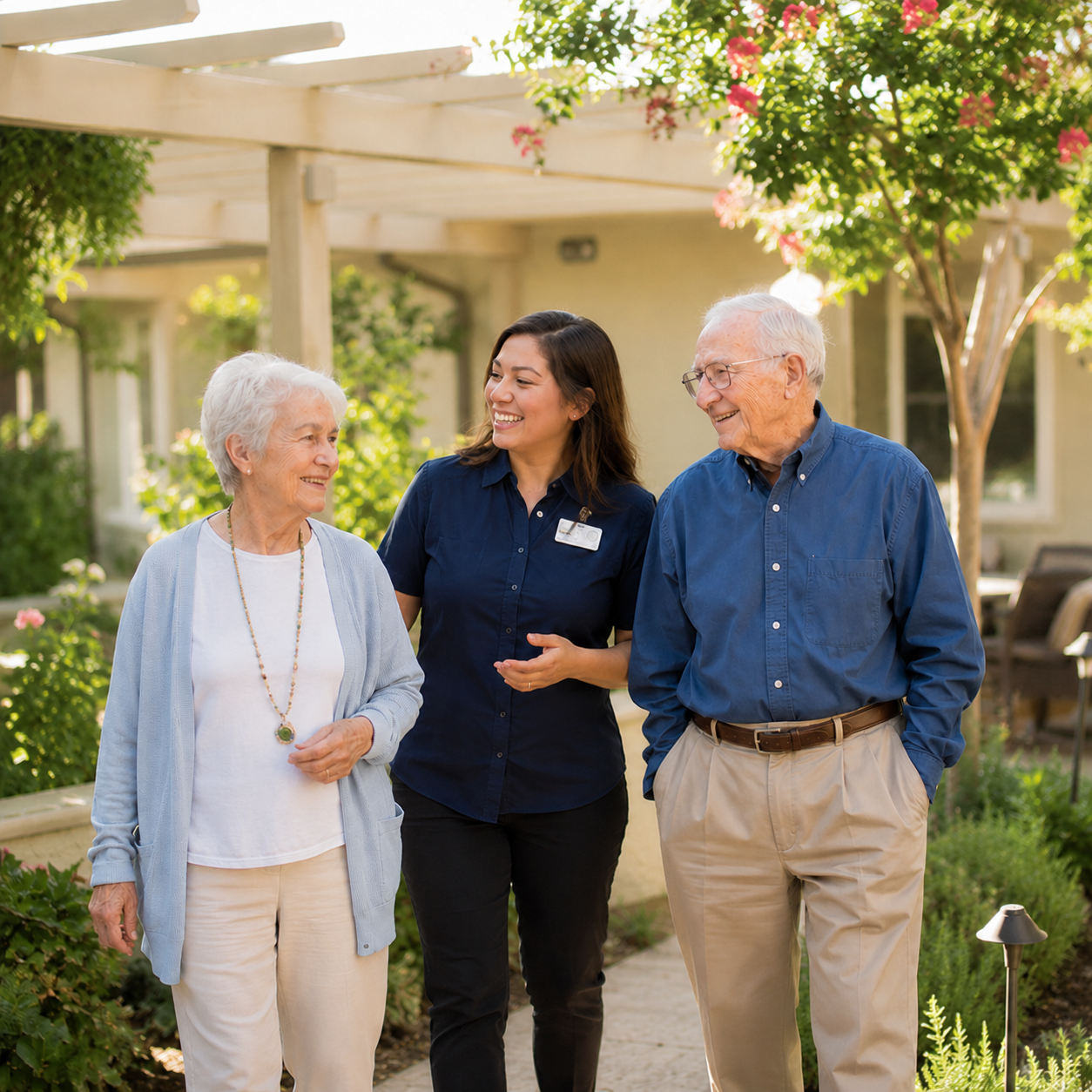
Assisted living provides help with daily tasks such as bathing, dressing, and medications in a residential setting with 24-hour staff. Skilled nursing provides licensed nursing care and therapy for medical needs, either short-term after a hospital stay or long-term. The dividing line is whether your parent needs personal-care support or daily medical care.
What Is Assisted Living?
Assisted living is for people who need regular, hands-on help with activities of daily living but do not need a nurse every day. In California, assisted living communities are licensed by the Department of Social Services as Residential Care Facilities for the Elderly (RCFEs). That license covers staffing, training, and resident assessments; it does not make the community a medical facility.
Assisted living typically includes:
Help with bathing, dressing, grooming, toileting, and getting around
Medication management, so doses are taken on time and not doubled
Meals, housekeeping, and laundry
24-hour caregivers, with staff awake overnight
A written care plan that is reviewed as needs change
What it does not include is daily clinical care. Support comes from trained caregivers, not licensed nurses, and the setting feels like home.
What Is Skilled Nursing?
Skilled nursing is medical care delivered in a residential setting. In California, skilled nursing facilities are licensed by the Department of Public Health and are Medicare-certified, which means they meet federal standards for nursing care.
Skilled nursing generally provides:
Registered nurses and licensed vocational nurses on site around the clock
Physician oversight of each resident's care
Physical, occupational, and speech therapy
Wound care, IV medications, and injections
Post-surgical recovery and monitoring
There are two paths into skilled nursing. The first is short-term rehabilitation after a hospital stay: a few weeks of nursing and therapy to regain strength after surgery, a stroke, or a serious fall, then home or back to assisted living. The second is a long-term stay for ongoing medical needs. Our article on skilled nursing vs long-term care explains that distinction.
Key Differences: Assisted Living vs Skilled Nursing
Target Audience & Resident Needs
Assisted Living: Designed for individuals who are medically stable but need assistance with daily living activities (ADLs).
Skilled Nursing: Designed for residents requiring daily professional nursing care or therapy, either short-term or long-term.
Staffing & Supervision
Assisted Living: 24-hour caregivers with nurse oversight for care plans.
Skilled Nursing: Registered Nurses (RNs) and Licensed Vocational Nurses (LVNs) available around the clock, with physician oversight.
Medical Care & Services
Assisted Living: Medication management and coordination with outside doctors.
Skilled Nursing: Complex care including wound care, IV medications, rehabilitation therapies, and post-surgical recovery.
California Licensing
Assisted Living: Licensed as a Residential Care Facility for the Elderly (RCFE) by the Department of Social Services.
Skilled Nursing: Licensed by the Department of Public Health and Medicare-certified.
Length of Stay & Setting Environment
Assisted Living: Typically long-term (months to years) in a residential, home-like setting with apartments, shared dining, and activities.
Skilled Nursing: Short-term (weeks for rehab) or long-term for ongoing medical needs, provided in a clinical environment with nursing stations and medical equipment.
Financial Coverage
Assisted Living: Primarily private pay or long-term care insurance; not covered by Medicare.
Skilled Nursing: Medicare may cover a short-term rehabilitation stay following a qualifying hospital stay; long-term care relies on private pay or other sources.
On payment: Medicare does not pay for assisted living, which it considers custodial care. It may cover part of a short-term skilled nursing stay after a qualifying inpatient hospital stay. For long-term stays, ask each community what payment sources it accepts. Our guide to custodial care vs skilled care explains how these definitions affect coverage.
Signs Assisted Living Is Enough
For many Los Angeles families, assisted living is the right answer even when a parent seems frail. It often fits when your loved one:
Needs help with showers, dressing, or getting to the bathroom
Has stable, well-managed conditions such as diabetes, high blood pressure, or arthritis
Takes several medications and needs someone to manage them
Is eating poorly, losing weight, or skipping meals at home
Has had a fall or a close call, but recovered without ongoing treatment
Sees a doctor for routine visits, not daily monitoring
The common thread: the need is for support, supervision, and routine, not daily clinical skill.
Signs Skilled Nursing Is Needed
Skilled nursing becomes the right level when medical needs outpace what caregivers can safely provide. Signs include:
Daily nursing tasks such as injections, catheter care, or monitoring unstable vital signs
Complex medications that require licensed administration or IV delivery
Wounds, pressure injuries, or surgical sites that need professional care
Recovery after surgery, a stroke, or a serious fall, with a therapy plan
Feeding tubes or oxygen management
Conditions that need physician oversight and frequent treatment changes
If a hospital team says your parent needs "skilled care," they mean this level. It is a clinical definition, not a judgment about how much your parent can do. If you are unsure which list fits, talk with our team about what an assessment would show.
The Gray Zone: What Is In Between?
Many parents do not fit neatly on either side. They need more than a standard assisted living care plan but are not sick enough for a nursing home. Families in Eagle Rock, Glendale, and Pasadena ask us about this often. There are usually three options:
A higher assisted living care tier. A higher tier can add more frequent checks or more hands-on help without a change of setting.
Memory care, if cognition is the driver. When the real issue is confusion, wandering, or judgment rather than a medical condition, a secured memory care neighborhood with staff trained in dementia support is often a better fit than skilled nursing.
A short skilled nursing stay, then a step down. A few weeks of rehabilitation after a hospitalization can restore enough strength to return to assisted living.
A level of care assessment settles the question. A nurse reviews mobility, medications, cognition, and daily routine, then recommends the setting that matches. It replaces guesswork with a professional picture and gives siblings something concrete to agree on.
Moving Between the Two: Why a Campus With Both Matters
Needs rarely move in one direction. A parent in assisted living breaks a hip and needs rehabilitation. Or a parent recovers in skilled nursing and no longer needs a nurse every day. In a single-level community, each of these moments means a new search, a new admission, and new faces at a hard time.
On a campus with both, the picture is different:
Recover in skilled nursing, return to assisted living. After rehabilitation, your parent goes back to the same apartment, dining room, and caregivers.
Decline in assisted living, move to skilled nursing without leaving. The move is across campus, not across the city.
Compare that with the hospital-discharge scramble: a planner hands you a list on Friday, a bed must be found by Monday, and the choice is whatever is open. A full continuum means not making that decision on a deadline.
Questions to Ask a Community
These questions reveal what a community can actually do:
What licenses do you hold, and can I see your most recent state inspection results?
Who is on site overnight: caregivers, licensed nurses, or both?
How do you decide when a resident needs a higher level of care, and who makes that call?
If my parent needs skilled nursing after a hospital stay, where would that happen?
Can my parent return to assisted living after rehabilitation?
What payment sources do you accept at each level of care?
Why Families Choose Solheim
Solheim Senior Community is a nonprofit Life Plan Community in Eagle Rock, serving Northeast Los Angeles since 1923. Assisted living, skilled nursing, rehabilitation, memory care, residential living, and respite care are all on one campus, so a parent can move between levels of care without leaving the community. Solheim was recognized by U.S. News and Newsweek among 2024's best continuing care and nursing home facilities. Families from Highland Park, Glendale, Pasadena, and across Los Angeles come to us for steady, experienced care that adjusts as needs change.
Schedule a tour or talk with our team about the right next step.
FAQ
-
Assisted living provides help with daily tasks such as bathing, dressing, and medications in a residential setting with 24-hour caregivers. Skilled nursing provides licensed nursing care, physician oversight, and therapy for daily medical needs. Solheim Senior Community in Eagle Rock, Los Angeles, offers both on one campus, so residents can move between them as their needs change.
-
It depends on whether the need is personal-care support or daily medical care. Help with bathing, dressing, and medications points to assisted living; daily nursing, wound care, or therapy after a hospital stay points to skilled nursing. A level of care assessment settles it. Solheim Senior Community in Eagle Rock, Los Angeles, can assess your loved one and recommend the right fit.
-
For many families, the answer is a higher assisted living care tier, memory care if cognition is the main concern, or a short skilled nursing stay followed by a return to assisted living. A level of care assessment identifies which applies. Solheim Senior Community in Eagle Rock, Los Angeles, offers all of these on one campus and can adjust care without a move.
-
Medicare may cover part of a short-term skilled nursing stay when it follows a qualifying inpatient hospital stay and a physician orders daily skilled care. It does not cover assisted living or memory care, which are considered custodial care. Ask each community what payment sources it accepts. Solheim Senior Community in Eagle Rock, Los Angeles, can walk you through the options for your parent.
-
Yes, when both levels are on the same campus. After rehabilitation, many residents regain enough strength to return to assisted living rather than stay in skilled nursing long-term. At Solheim Senior Community in Eagle Rock, Los Angeles, a resident can recover in skilled nursing and return to their assisted living apartment without leaving the community.
